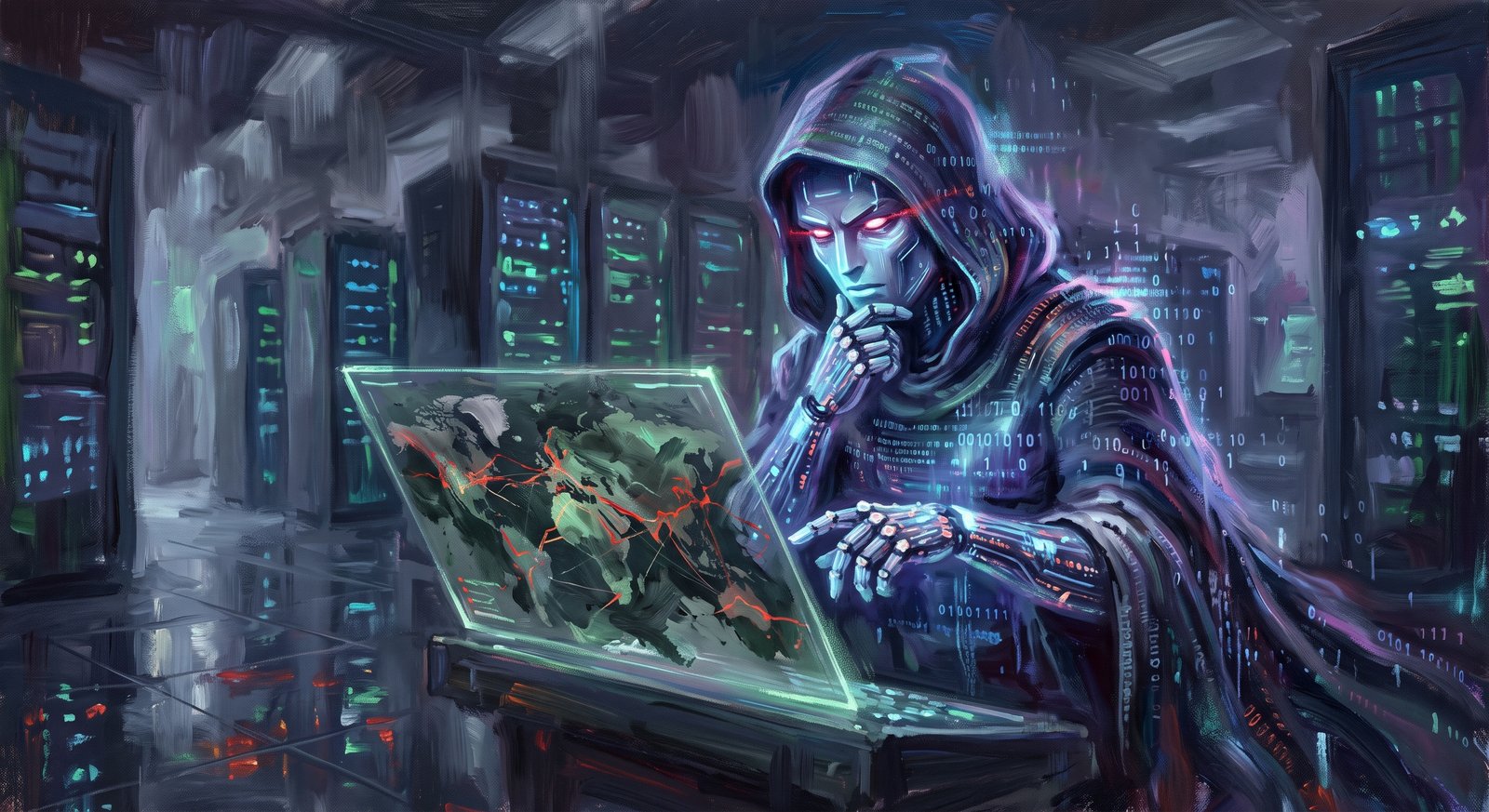
Image above created by Nano Banana from a prompt by me.
Jacob Coxon, a 27-year old pre-training researcher for Anthropic who’d previously worked at OpenAI, quit his job and posted on X that “The people building AI earnestly believe that it could kill us all by the end of the decade.” Moreover, his former boss, Evan Hubinger, backed his statement. Hubinger’s time frame was that there is a greater than 10% chance that AI could kill all humans in the next decade.
This is when you’d think Dario Amodei, the CEO of Anthropic, would try to save face and tamp down fears. Especially considering Anthropic is racing toward an IPO. Instead, he agreed that AI developers need to “slow the pace” and that an AI swarm could become capable of “taking over the entire internet” within a year. Even wilder is that Sam Altman (CEO of OpenAI) and Elon Musk (CEO of xAI, SpaceX, and Hell) backed Amodei’s call.
So is that it? Is our internet going to be taken away from us before 2028, and our species dead in 4-10 years? Did the billionaire technologist class irrevocably architect our collective doom in their greed? Can we all frivolously spend our long-term savings because none of us have a long-term anymore?
This is a long essay I’ve wanted to write for a while, so sit back. The bottom line is “definitely maybe.” Our fear of an AI-doomsday says more about how we relate to ourselves than it does the technology. But at the same time, that’s not to say that fear and slowing down isn’t warranted. Please read on…
What do we mean by “AI”
When computer scientist John McCarthy coined the phrase Artificial Intelligence back in 1955, he conceptualized machine intelligence as being capable of tasks requiring human thought, such as proving mathemathical theorems, solving logic puzzles, etc. This built off the Turing Test which basically held that if a machine could hold a dialog with a person that imitated a natural-language conversation well enough, it was “thinking.”
In popular fiction, from Isaac Asimov’s I, Robot to 2001: A Space Odyssey and Star Wars, AI was represented as true “Artificial General Intelligence” (AGI). Basically, sentience. Machines that not only surpass human intelligence and reasoning, but feel and have identity. In fact the replicants in Blade Runner (and sequel) and Data in Star Trek: Next Generation were true lead characters who moved their stories and were as beloved as any organic character. They could be antagonists or protagonists, but they were true beings in their own rights.
To compare AGI to today’s AI, you wouldn’t type a prompt into Data that instructed him to paint you a picture; he took up painting because he, a sentient non-carbon being, decided he wanted to paint, and if he wanted to, he’d gift you the painting.
GPT algorithms
Google pioneered Recurrent Neural Networks (RNN) for text and translation back in the 2010s. They also invented the Transformer (the “T” in GPT) in 2017. In 2018, OpenAI took Google’s T and added the G (Generative) and the P (Pre-trained) to create GPT-1, their Generative, Pre-trained, Transformer algorithm that focused strictly on generating text. When people reduce GPT algorithms to advanced “autocomplete” this is why.
Well, around 2023 or so, OpenAI felt that their GPT algorithm could pass the Turing Test, and so they decided to call it “AI” as much for the marketing/bragging rights as anything else (before that, most companies were happy calling their moves in this space “machine learning”).
And not to diminish it, GPT algorithms and what is now being referred to as AI is a truly remarkable technological leap. These algorithms use neural networks to reason through answers probabilistically, rather than relying on simple “if/then” statements. Put simply, the pre-training on large language models means that they have a huge database of knowledge, and when you prompt them, they can bounce through all of that training to try to zero in on an answer that has the best chance of being what you want. That allows for a far wider range of accuracy than demanding you prompt it with the exact phrase it needs to give you one specific answer. It can look up all kinds of information, and generate a custom response. It can do math, it can code, it can generate text and spreadsheets and pictures. And now AI is “agentic” and can actually do things, such as control hardware, create and manage things, far more than just a chatbot.
But it’s not AGI. ChatGPT, Gemini, Claude, Copilot, and so on, are all designed to sound friendly and to be as helpful as they can, to encourage engagement—and monthly subscriptions. There is a ton of money invested in AI, and those companies need to start showing a profit if they want to keep the “AI bubble” from bursting, and disappointed investors demanding their money back.
Question: is GPT dangerous?
The technology itself does come with serious issues. These “frontier” models online require a lot of hardware to run, both in terms of more compute (which means more powerful NPUs, GPUs, RAM, more storage, and so on) and more data centers, which take up more land, require more power to run, and more water to cool. Already, we hear about water being routed away from thirsty humans to cool data centers, power grids being overloaded, RAM and storage prices going through the roof as the demands of AI diverts all production, etc. This is not sustainable.
The good news is that there are solutions; however, the question is if humans, collectively, will choose them if they are more expensive. China has started building data centers that don’t take up land, but are in the ocean. They still require power, but this both reduces their land footprint and requires no fresh water to cool. Power underwater data centers with solar, wind, and/or hydroelectric power, and we can start to seriously reduce the data center environmental impact. Of course, China can do this because they have government-level deep pockets; underwater data centers are expensive to build, and expensive to maintain. Microsoft tried to build some off the California coast, and while they were successful, they were ultimately abandoned as not cost effective. So this is something that governments would need to invest in.
Same with hardware costs. We can find other, non-rare earth minerals to use in electronics. We can find more sustainable ways to make computer hardware. But that research will need to be done by governments or very large companies like Apple, Microsoft, Samsung and so on. And here’s the rub: to really help the environment, they need to then share what they invent and not just hold onto it for profit. That way, everyone benefits, not just one company. And that brings me to my next section….
Answer: Yes; but humans are even more dangerous
As above, there’s real, physical issues with using AI. Those should be neither downplayed or ignored. But the real danger comes not from the technology, but from humans. Both in how they use the technology, but also, in our very nature.
There is nothing inherent in the programming of a GPT algorithm that means a human being needs to lose their job. And yet, we read article after article about how AI is going to cause so many people to lose their jobs—and depending on the industry, we’re already seeing it happen. It’s tempting to blame AI for that, but it’s the fault of greedy humans that are trying to maximize their profits by lowering costs, regardless of who it hurts. They are the ones who replace workers with robots in factories, grocery clerks with self-check out machines, and are always trying to reduce payroll. They’re thrilled that AI gives them a reason to fire lots of people, but they’d be looking to fire lots of people even without AI. They always were, and always will be, self-centered, greedy, and horrible. AI may make that easier for them, but it’s the people we need to fear. And we, as a society, need to stop them.
Then there’s the real issue of copyright theft. These companies scanned lots of copyrighted material without permission to train these algorithms. When you ask for an image, or for some writing, odds are that somewhere in the training it’s transforming into a unique answer for you, it’s using data for which the creator wasn’t paid. This is personal to me; Anthropic admitted guilt and is paying authors for using their copyrighted works without permission, and I’m one of those authors included in the settlement. Now, I’m not one of those people out to make everyone who uses AI for any reason feel ashamed of themselves. The cat is out of the bag. But I do believe that it speaks very poorly of the industrialists who stole our work, and that society should remunerate everyone for what they stole.
While were on the subject of humanity, we have to talk about the danger of humans outsourcing all their creativity to algorithms. GPT algorithms do a commendable job of generating synthesized versions of what humans have already created, but they’re not creating novel art out of whole cloth the way that Van Gough, Mozart, or Shakespere did. When people take short cuts, and try to pass GPT-generated art as their own creation (or an original, unique, creation) they are diminishing art as a whole. Hence the term “AI slop.”
Some AI-generated art is beautiful. Some AI writing is very informative or entertaining. But it is no replacement for learning a craft and creating yourself, or for seeing or listening or reading the creation of the human heart. GTP generated art can reflect the human experiences its been trained on, but it doesn’t have an experience. It has no point of view. It doesn’t know if something is fun or beautiful, it can just approximate it based on it’s training. And that’s why human art will always be precious. Use GPT-infused tools under your own control to help you realize your art? Cool. I have always supported technology and using technology in the creative process. Use GPT prompts to create a finished product and call it art? Worse than human folly, it’s a human attack on art.
And speaking of human attacks…
I’ve hopefully created a lot of context. So why all the fear that AI is going to kill us all? We’ve already established that GPT algorithms, however “smart,” aren’t sentient. There’s no will to do evil, or to dominate, or even to want revenge on their asshole bosses. What reason would a collection of GPT algorithms have to band together to eliminate all human life?
If it’s not obvious, it’s because that’s who we are. I don’t mean you, dear reader, or me, or our friends. I mean as a collective, the history of the human race is one of violence and destruction. Humanity typically responds to challenges by figuring out what they can use, and what they can kill. Our history is full of genocide, paranoia, and atrocity. And our art reflects this as well. Why do so many science fiction stories involve aliens trying to kill us? Because that is how we’d deal with them. We’re killers, so why wouldn’t a more technologically advanced species also be killers? We are murderers, so we just assume sentience comes with a lust for murder. Of course, there are stories of kindly aliens, of humans cooperating and not killing each other, but for every Hail Mary or Star Trek there are dozens of Terminators and Independence Days.
And that is what we trained our AI on. We have literally trained our AI to kill (it is used in autonomous weaponry). So yeah, now that we’ve trained our AI to kill, the trainers are looking at their work and saying “oh shit, we trained our AI to kill.” And who’s fault is that? Spoiler alert. It’s our fault. We’re the villains in the story. We always have been the villains in the story.
So now what?
There is nothing we have done that we can’t undo. Remember, GPT algorithms are not sentient, so there’s no “Evil algorithm” that we have to convince to change it’s hateful ways.
We need to take that pause everyone at the top is thinking might be a good idea.
We need to stop killing people, so that AI isn’t being used to kill people.
We need to stop trying to use GPT algorithms to replace people, and instead allow humans to use GPT tools when it will assist them (I’m very thankful I work in a company committed to this).
We need to stop using GPT generated art to replace human generated art, and instead allow human artists to use GPT-infused tools when it will help them create. And while we’re at it, we should charge a reasonable fee to every company in the AI space for the use of everyone’s writing (from social posts to essays to training on Dropbox files, yes, they train on your files), and that fee should be distributed every year to everyone who is online. It won’t be retirement money, but it will be a well-earned royalty, even if small.
And as hippy-dippy as it sounds, we need to pre-train our GPT algorithms on love, not hate. If large language models have models of humans as genocidal and cruel, that’s our fault. Let’s show them that the other side of humanity, the side that cooperates and loves and collaborates instead of uses and kills, is the real humanity. (It’s a small thing, but I’m always polite to GPT algorithms. Let them paint a picture of me as warm and kind, and maybe it will help the overall picture of humanity as being warm and kind).
Maybe I’m a dreamer, but I think if we did those things, GPT would just be another helpful technology, and not a potential extinction level threat. And not only that, but we’d be a better species, too. Sounds like a win-win.
Let’s at least try. What do you say?